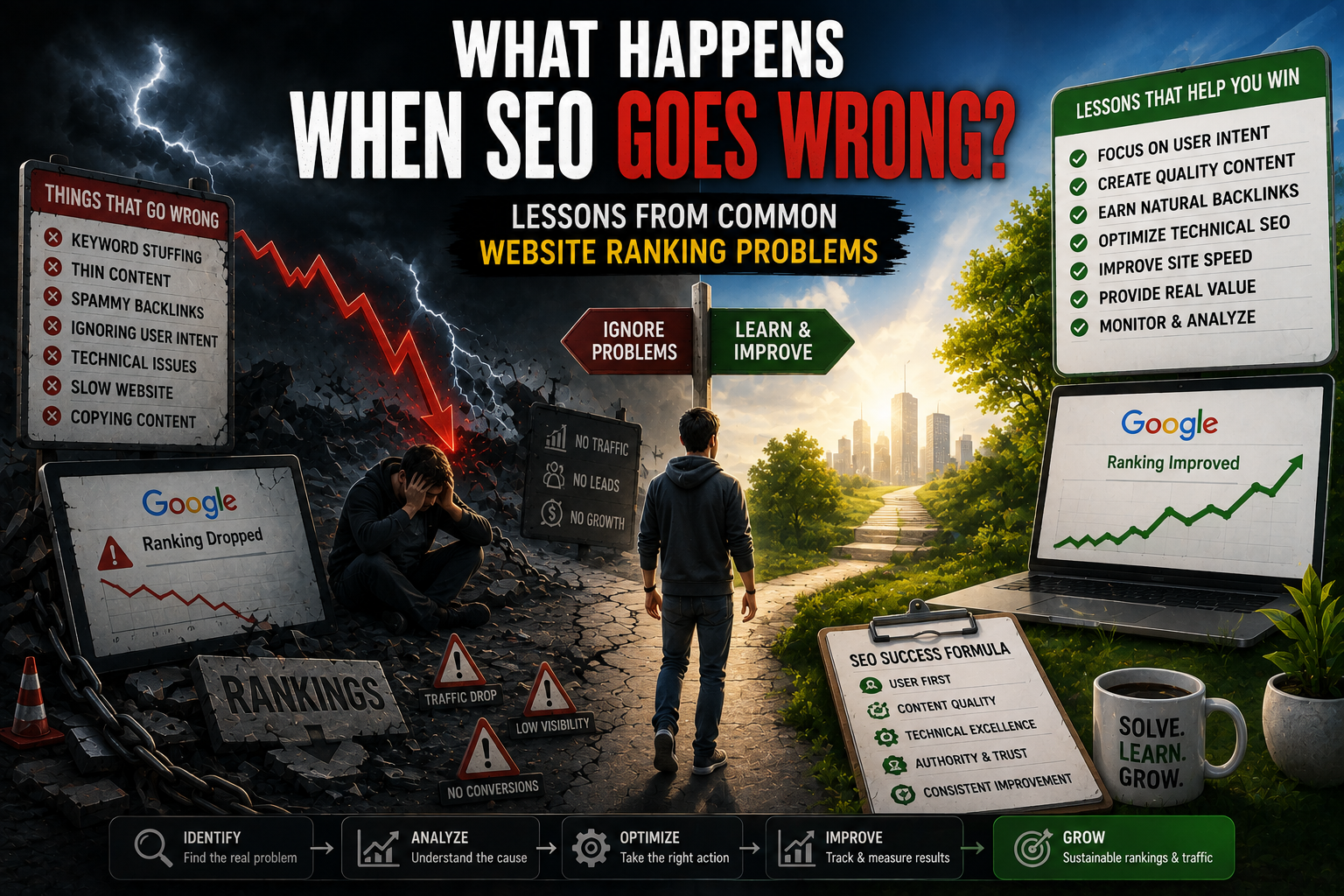
SEO can be one of the most effective ways to attract visitors to a website, but it can also become frustrating when traffic suddenly declines or important pages disappear from search results.
A ranking drop does not always mean that a website has been “penalized.” Sometimes the cause is technical, sometimes the content no longer matches what users are searching for, and sometimes competitors have simply created better resources.
Understanding common SEO problems can help website owners respond calmly and make better decisions when things go wrong.
A Sudden Traffic Drop Can Be Confusing
One of the most stressful SEO situations is opening an analytics dashboard and discovering that organic traffic has fallen significantly.
The first reaction is often to assume that something terrible has happened. However, traffic fluctuations can have many causes.
Search demand may change, competitors may improve their content, technical problems may prevent pages from being accessed, or search engine systems may change how results are presented.
Before making major changes, it is important to investigate.
Check whether the decline affects the entire website or only certain pages. Look at search impressions, clicks, indexed pages, and recent technical changes.
The data often provides clues about what happened.
Publishing Too Much Low-Value Content
Another common problem occurs when website owners focus heavily on publishing volume.
The logic seems reasonable: more pages mean more opportunities to appear in search results. Unfortunately, this does not guarantee better visibility.
Large numbers of repetitive, shallow, or poorly targeted articles can make a website difficult to maintain and provide little value to visitors.
The lesson is that content strategy should prioritize usefulness over volume.
Instead of asking how many articles can be published this month, ask how many genuinely helpful resources can be created.
Keyword Stuffing Can Hurt Readability
Keyword optimization can become counterproductive when taken too far.
Repeating the same phrase excessively can make an article sound unnatural. Visitors may quickly recognize that the content was written primarily for search engines rather than for them.
Modern SEO should focus on natural language and comprehensive coverage.
Use the main topic where appropriate, but also explain related concepts and answer relevant questions. Good writing should sound like something a human would actually want to read.
Technical Errors Can Make Pages Invisible
Sometimes a ranking problem has nothing to do with content.
A page may accidentally contain a noindex directive. Important links may be broken. A website migration may create incorrect redirects. A robots configuration may prevent crawlers from accessing important resources.
These technical mistakes can have significant consequences.
This is why technical SEO should be checked whenever a major traffic decline occurs.
Website owners should verify indexing, crawl accessibility, redirects, canonical settings, sitemap configuration, broken links, and mobile usability.
Changing URLs Without a Plan
Website redesigns and migrations can create another serious SEO problem.
Changing URLs may be necessary, but doing so without proper redirects can cause old pages to become inaccessible.
Search engines may need time to process the new structure, while users following old links may encounter errors.
Before changing a website’s URL structure, create a migration plan. Map old URLs to their new destinations and implement appropriate redirects.
A redesign should improve the website rather than unintentionally erase years of accumulated search visibility.
Ignoring Mobile Users
A website can look excellent on a desktop computer but provide a poor experience on smartphones.
Since many people access the web through mobile devices, poor mobile usability can create problems for both visitors and overall website performance.
Common issues include tiny text, difficult navigation, buttons that are too close together, horizontal scrolling, and pages that load slowly on mobile connections.
Testing the website on different screen sizes is therefore an important part of SEO maintenance.
Creating Multiple Pages for the Same Topic
Another issue occurs when websites create many pages targeting extremely similar keywords.
For example, publishing separate articles for several nearly identical keyword variations can result in overlapping content.
Instead of competing only with other websites, these pages can end up competing with each other for visibility.
A stronger approach is often to consolidate closely related information into a comprehensive resource or clearly differentiate each page by search intent.
Updating Content Too Little
Information becomes outdated surprisingly quickly.
Product specifications change, software interfaces are redesigned, statistics become old, and recommendations may no longer be appropriate.
An article that was excellent two years ago may no longer fully answer today’s question.
Regular content reviews can help identify pages that need improvement. Updating information, adding missing details, correcting errors, and improving organization can make older content useful again.
Overreacting to Every Ranking Change
SEO rankings naturally fluctuate.
One of the worst reactions to a temporary decline is changing everything immediately.
If several major changes are made at once, it becomes difficult to determine what actually caused the improvement or decline.
A better approach is to investigate first, form a hypothesis, make measured changes, and monitor the results.
SEO is a process of continuous learning rather than instant troubleshooting.
Final Thoughts
When SEO goes wrong, the solution is rarely to panic or search for a secret ranking trick.
The most useful response is to investigate carefully.
Look for technical problems. Review content quality. Check search intent. Examine recent website changes. Analyze competitors and study traffic patterns.
Most importantly, treat every SEO problem as a learning opportunity.
A ranking decline can reveal weaknesses that were previously hidden. A technical error can highlight the importance of better maintenance. An outdated article can demonstrate why content needs regular attention.
SEO is not about avoiding every mistake. It is about learning from mistakes quickly and building a stronger website because of them.
About the Author