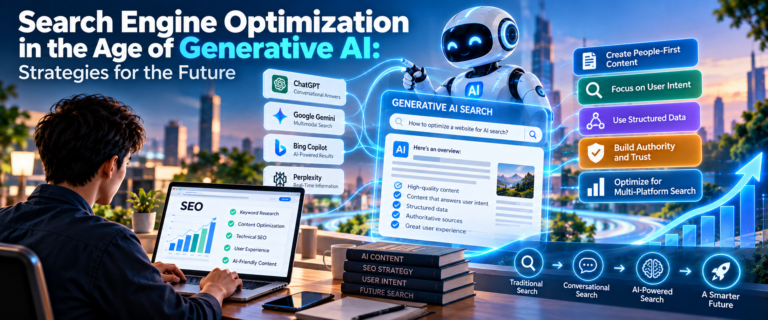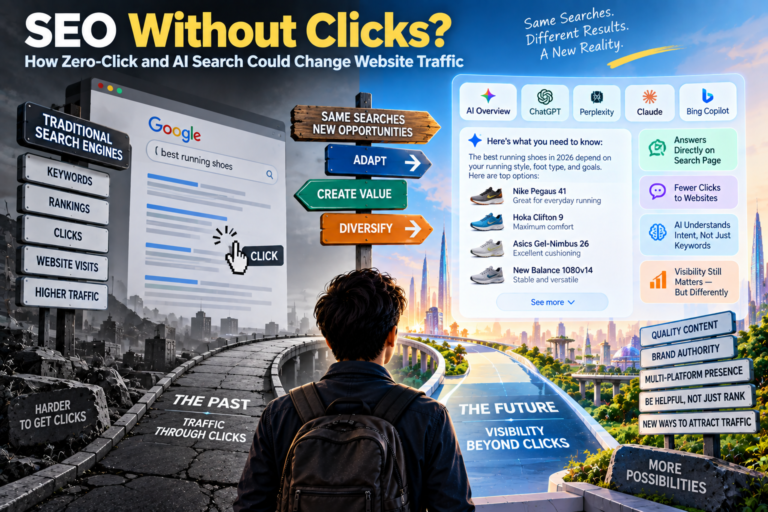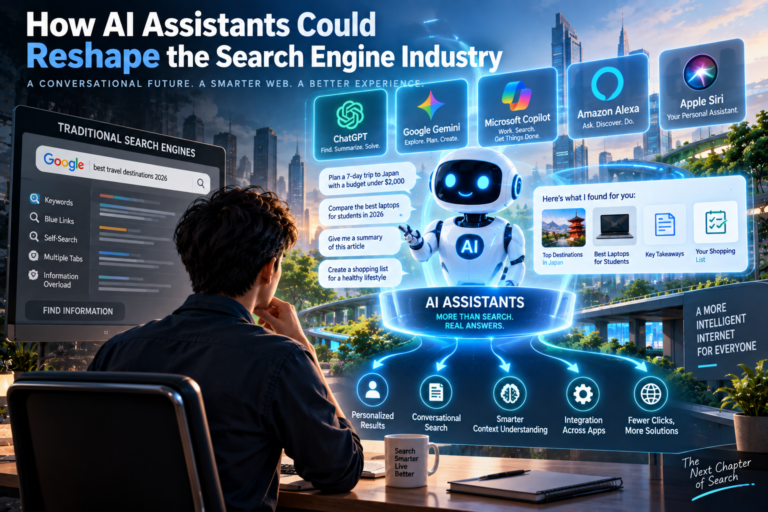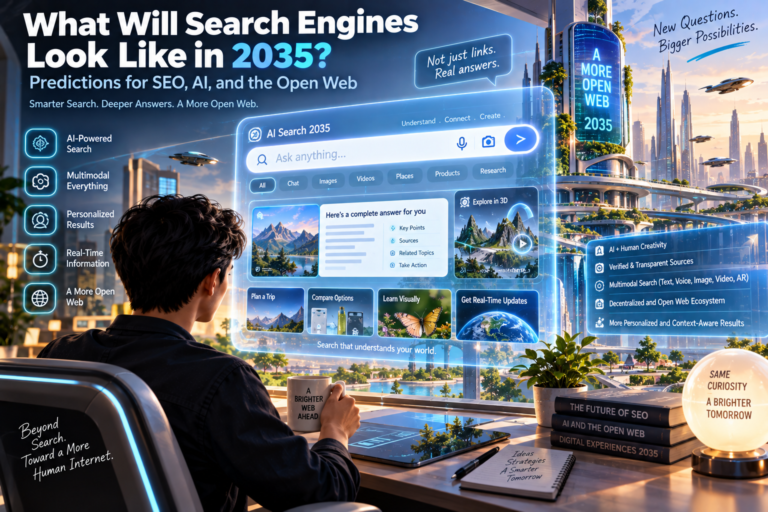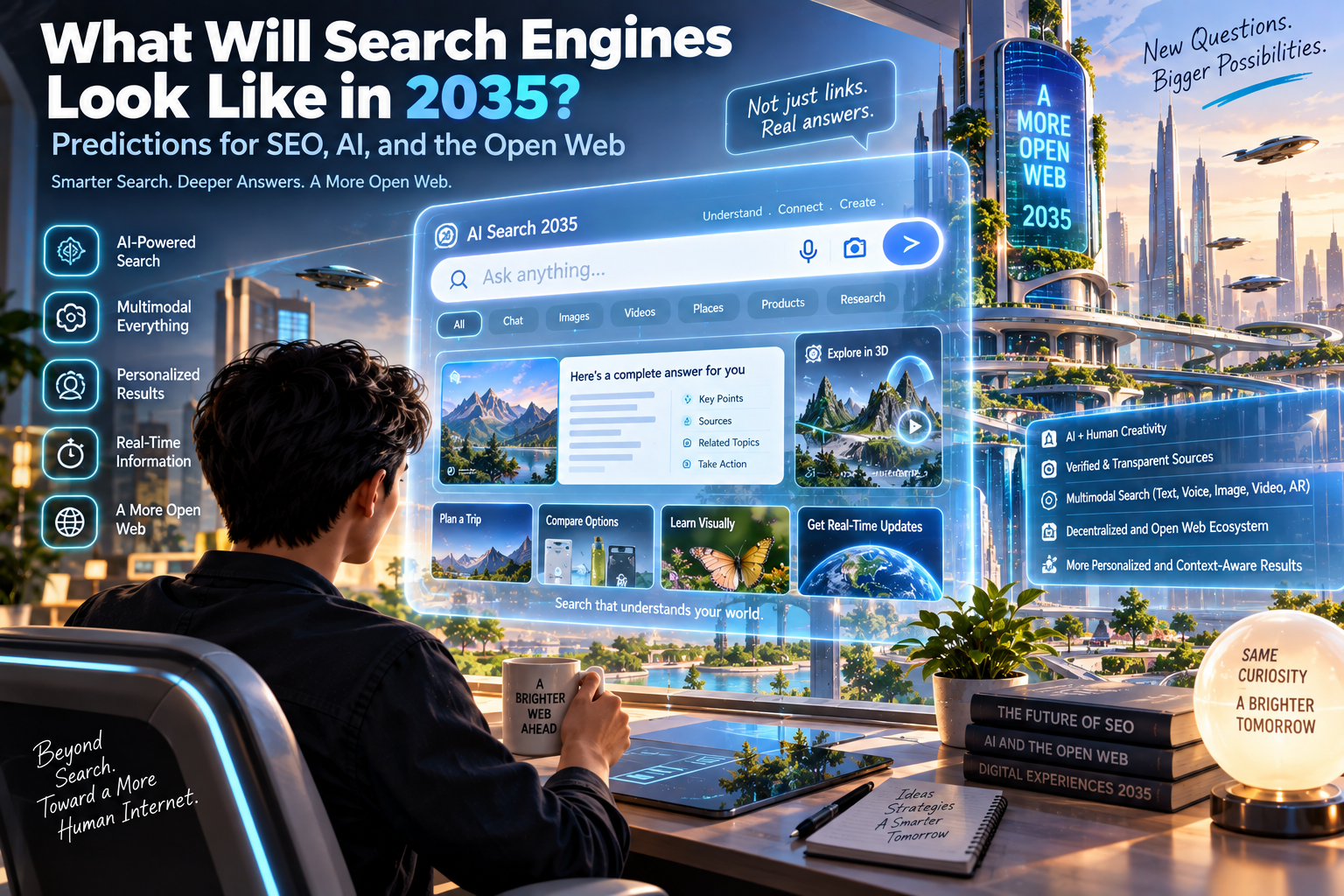
Predicting technology ten years into the future is difficult. Search engines in 2035 may include capabilities that seem experimental today, while some technologies currently receiving enormous attention may become less important.
However, current developments in artificial intelligence, conversational interfaces, multimodal computing, and online publishing provide clues about possible directions.
Rather than predicting one specific future, it is useful to consider several changes that could shape how people discover information.
Search Boxes May Become Less Important
The familiar rectangular search box has dominated web search for decades.
By 2035, searching may happen more naturally through conversations.
Users might interact with AI assistants through phones, computers, cars, smart glasses, headphones, or devices that have not yet become mainstream.
Instead of entering separate keywords, people could describe objectives.
For example:
“Find a quiet place for a three-day vacation that I can reach by train, with moderate temperatures and a reasonable budget.”
The system could help research and refine the request interactively.
Search Could Understand Multiple Media Types
Future search systems may interpret text, images, video, audio, and physical surroundings together.
A user could point a camera at a machine and ask how to repair it.
Another person might upload a photograph of a building and ask about its architectural style.
A student could provide a diagram and request an explanation.
This multimodal search environment would expand optimization beyond written pages.
High-quality images, descriptive media, diagrams, transcripts, video, and structured information could become increasingly valuable.
Search Results Could Become Personalized Interfaces
Today, many users receive relatively similar search result layouts.
Future systems could construct results dynamically around the task.
A travel search might produce an interactive itinerary.
A financial question might generate a calculator.
A product search could provide a comparison interface.
An educational question might produce a step-by-step lesson.
Search results could therefore become applications rather than static lists.
Websites Could Become Data and Experience Providers
If AI interfaces answer more questions directly, what happens to websites?
Websites may increasingly differentiate themselves through original information and experiences.
A weather site can provide specialized forecasting tools.
A real estate website can provide property databases.
A tourism website can provide booking services, maps, and original local guides.
A software publication can provide benchmarks and interactive comparisons.
Websites that provide unique functions may remain important even if basic information increasingly appears directly within search interfaces.
SEO Could Become Machine Understanding Optimization
SEO in 2035 may involve ensuring that information is understandable across many intelligent systems.
Clear entities, relationships, authorship, dates, sources, and structured information could become increasingly useful.
This does not mean websites should be written for robots instead of humans.
The strongest information structures often benefit both.
A well-organized article with clear headings, accurate definitions, transparent sources, and useful examples is easier for people and machines to interpret.
Authenticity Could Become More Valuable
As synthetic content becomes easier to generate, proving the origin of information may become more important.
Readers may increasingly value identifiable authors, first-hand reporting, original photographs, transparent methodologies, and verifiable sources.
Search systems may also develop more sophisticated approaches to evaluating provenance and reliability.
The ability to create unlimited text does not automatically create unlimited trustworthy knowledge.
The Open Web Will Face Important Questions
AI search also raises broader questions about the future of publishing.
Websites invest time and money in creating journalism, tutorials, research, databases, and other resources. If discovery platforms provide answers without sending sufficient visitors to original publishers, sustainable publishing models may need to evolve.
Possible responses could include subscriptions, licensing arrangements, memberships, direct audience relationships, advertising innovations, and new forms of attribution.
How this relationship develops could significantly influence the open web.
SEO Professionals Could Become Information Strategists
By 2035, the role of an SEO professional may extend far beyond keyword research.
SEO specialists could work with structured information, content strategy, user experience, brand visibility, AI discovery, analytics, digital PR, technical architecture, and multiple search platforms.
Their central question could change from:
“How do we rank this page?”
to:
“How do we make this organization discoverable and useful wherever people search?”
That represents a broader and potentially more strategic role.
What Website Owners Should Do Today
There is no need to optimize a website for an imaginary 2035 algorithm.
Instead, publishers can invest in durable fundamentals.
Create genuinely useful content.
Develop original resources.
Maintain accurate information.
Build a recognizable brand.
Improve technical quality.
Understand the audience.
Diversify traffic sources.
These principles remain useful under many possible technological scenarios.
Conclusion
Search engines in 2035 may look less like directories and more like intelligent assistants capable of understanding complex objectives, multiple media formats, and ongoing conversations.
SEO will probably evolve alongside them.
The most significant shift could be moving away from optimizing individual pages for individual keywords and toward building trustworthy information ecosystems that people and intelligent systems can discover.
Technology will change, but the fundamental reason people search will remain remarkably consistent: they have questions, problems, decisions, and curiosity.
The websites that help satisfy those needs will continue to have a reason to exist.
About the Author