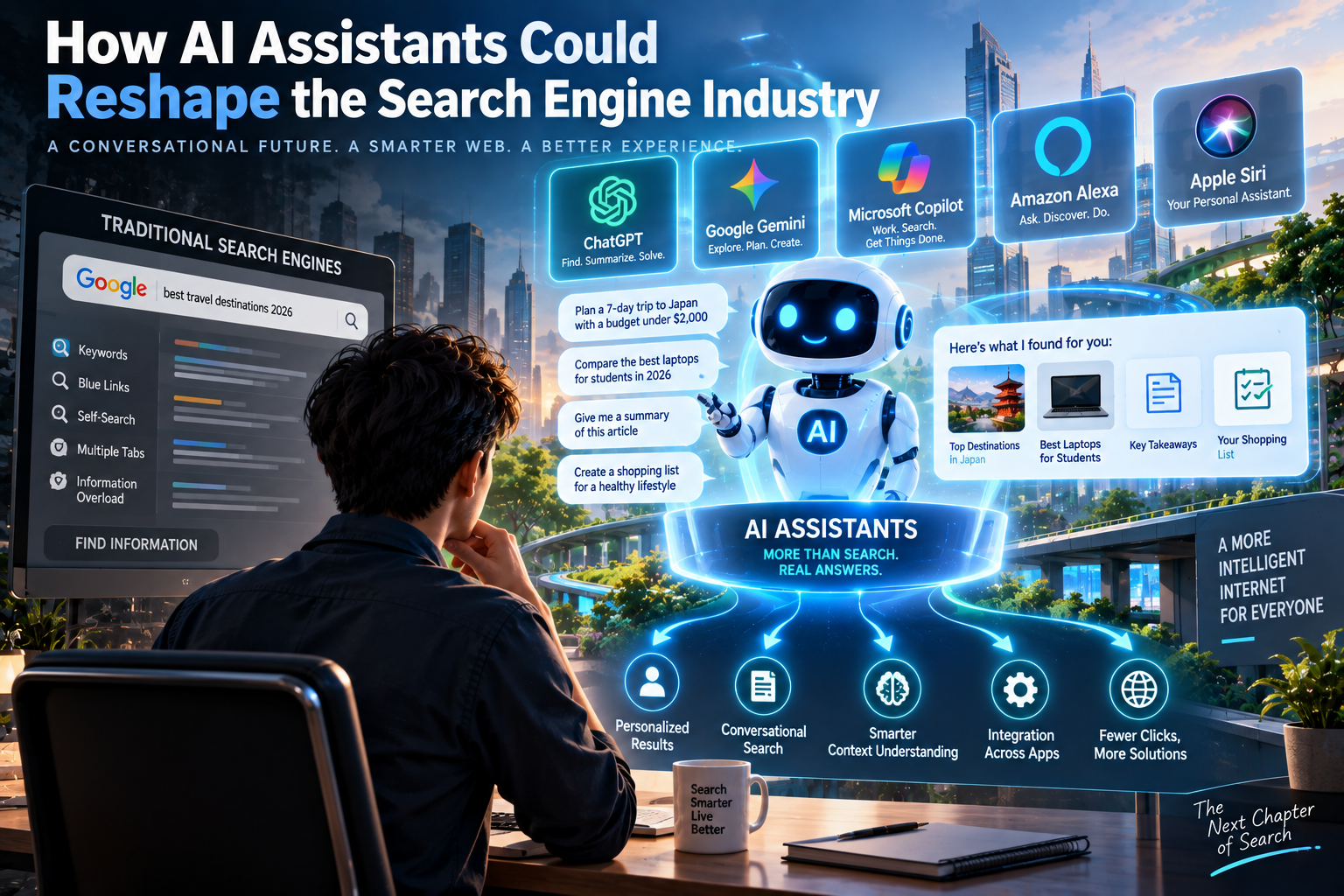
For many internet users, searching the web has traditionally meant opening a search engine, typing a few words, and selecting a result.
AI assistants introduce a different model.
Instead of providing only a list of websites, an assistant can participate in a conversation, remember context within that interaction, organize information, and help users complete complicated research tasks.
This development could reshape how people think about search itself.
Search Is Becoming a Conversation
Traditional search often involves multiple queries.
Imagine planning a five-day trip.
A traveler might separately search for hotels, transportation, attractions, restaurants, weather, ticket prices, and itineraries.
A conversational assistant can potentially handle these questions as parts of the same task.
The user could start with a broad request and gradually refine it:
“Make it cheaper.”
“Remove activities that require a car.”
“Which attractions are suitable when it rains?”
This interaction resembles working with an assistant rather than using a traditional search box.
Discovery Could Happen Across Many Platforms
Search behavior is already distributed across different services.
People discover information through search engines, video platforms, social networks, online marketplaces, maps, forums, and specialized applications.
AI assistants add another discovery layer.
As a result, businesses may eventually need to think beyond ranking in a single traditional search engine.
A restaurant, for example, may need accurate information across its website, maps, business listings, reservation platforms, reviews, and other relevant sources because users could discover it through multiple interfaces.
Websites Remain Important
AI assistants do not eliminate the underlying need for information sources.
Websites provide original reporting, documentation, products, services, tools, databases, communities, and first-hand accounts.
The role of websites could evolve from being merely pages that rank for queries toward becoming authoritative information resources that search and AI systems can reference.
This places greater importance on accuracy and clear publishing practices.
Reputation May Travel Across Platforms
A strong online reputation is not limited to one search engine.
When an organization is consistently discussed, cited, reviewed, and referenced across relevant places on the web, users have more opportunities to discover it.
Businesses can therefore think about visibility as an ecosystem.
Useful research, strong customer experiences, public documentation, expert contributions, and valuable tools can generate signals beyond a company’s own website.
Content Strategies May Become More Diverse
Written articles remain valuable, but future discovery may increasingly incorporate multiple formats.
A single research project might produce an article, infographic, short video, podcast discussion, dataset, and interactive calculator.
Different users prefer different ways of consuming information.
Multiformat publishing also gives content more opportunities to be discovered through different systems.
Search Optimization Could Become Discovery Optimization
The term SEO may eventually represent only one component of a broader discipline.
Businesses may optimize how information appears across traditional search engines, AI assistants, marketplaces, social platforms, maps, and industry-specific discovery systems.
The underlying objective remains familiar: make useful information easy to find and understand.
What changes is the number of places where discovery happens.
Avoid Chasing Every New Platform
New technologies often create excitement, but not every platform becomes important for every audience.
Businesses should evaluate where their customers actually spend time and how they search for information.
A local service business may benefit more from accurate local information than from an elaborate international content strategy.
A software company may benefit significantly from technical documentation and developer communities.
Strategy should follow audience behavior rather than hype.
Conclusion
AI assistants could reshape the search industry by transforming searching from a sequence of isolated queries into an ongoing conversation.
However, the future is unlikely to belong exclusively to one type of platform.
People will continue discovering information through websites, search engines, communities, videos, maps, marketplaces, and new AI interfaces.
For publishers and businesses, the opportunity is to build a reliable presence across the discovery ecosystem while continuing to create information and experiences that people genuinely value.
About the Author