
SEO is full of theories. Some strategies are supported by data, while others are based on personal experiences, assumptions, or observations from the search results. The problem is that something that works for one website does not necessarily produce the same result for another.
Over time, I learned that the best way to understand SEO is to test ideas carefully instead of accepting every popular recommendation at face value.
Several experiments changed the way I think about search rankings. They also taught me that successful SEO is less about manipulating individual ranking factors and more about creating a website that consistently satisfies users.
Experiment One: Publishing More Did Not Always Mean More Traffic
One of my earliest assumptions was simple: more content should create more opportunities to rank.
I tested this by increasing the publishing frequency. Instead of spending significant time improving individual articles, the focus was on producing more pages.
The result was not as impressive as expected.
Some articles received little or no organic traffic, while others overlapped with existing content. The website became larger, but not necessarily better.
This experiment taught me that content quantity is not the same as content value.
Eventually, I shifted toward fewer but more useful articles. Each piece had a clearer purpose and was connected to related content. The website became easier to manage, and the content strategy became more focused.
Experiment Two: Updating Old Articles Could Be Surprisingly Effective
Another experiment involved older content.
Rather than publishing something new, I selected existing articles that already had some search impressions but were not performing particularly well.
I updated outdated information, improved headings, added missing explanations, removed unnecessary sections, and strengthened internal links.
Some pages gradually improved.
This changed my perspective on content freshness. Updating an article is not simply about changing its publication date. The real value comes from making the page more useful and relevant.
It also showed me that existing content can represent an important SEO asset.
Experiment Three: Search Intent Beat Exact-Match Optimization
For a while, I experimented with exact keyword placement. I optimized titles, headings, URLs, and body copy around specific search phrases.
The pages were technically optimized, but some still struggled.
I then tried a different approach: focusing heavily on search intent.
Instead of asking how many times a keyword should appear, I asked what the searcher actually wanted.
If the query suggested that users wanted a tutorial, I created a step-by-step guide. If the query indicated comparison intent, I structured the article around meaningful differences and decision-making information.
This experiment changed my approach to keyword research permanently.
Keywords tell you what people type. Search intent helps explain why they type it.
Experiment Four: Internal Links Changed the Way I Structure Content
I also experimented with internal linking.
Rather than adding links randomly, I created relationships between broader guides and more specific supporting articles.
For example, a comprehensive article about SEO could link to dedicated pages covering technical SEO, content optimization, keyword research, and internal linking.
This created a logical content structure.
The experiment taught me that internal links are not merely an SEO technique. They can improve navigation and help visitors discover useful information.
When internal linking is designed around the reader, SEO benefits can become a natural side effect.
Experiment Five: Longer Articles Were Not Automatically Better
One popular assumption is that longer content performs better.
I tested this by comparing articles of different lengths.
The results reinforced something important: word count alone does not determine usefulness.
A long article can be valuable when the subject requires detailed explanation. However, adding unnecessary paragraphs simply to reach a target word count can make the content repetitive.
A concise article that directly answers a question may provide a better experience than a much longer article that takes too long to reach the point.
The lesson was to prioritize completeness and usefulness rather than an arbitrary word count.
Experiment Six: Rankings Are More Volatile Than They Look
Another important lesson came from monitoring rankings over time.
Pages moved up and down even when no major changes were made. A page could gain visibility for several queries and then lose some positions later.
This taught me not to overreact to short-term ranking movements.
SEO data needs context. Looking at trends over weeks or months is often more useful than checking individual positions every day.
I also started paying more attention to organic traffic, impressions, clicks, engagement, and conversions rather than focusing exclusively on a single ranking number.
Experiment Seven: User Experience Matters
Perhaps the most important experiment involved improving the overall user experience.
I worked on readability, navigation, page layout, mobile usability, and making important information easier to find.
The goal was not to manipulate rankings directly. It was simply to make the website better.
This changed my understanding of SEO.
Search optimization is not an isolated activity. Website structure, content quality, usability, and technical performance all contribute to the overall experience.
Final Thoughts
These experiments taught me that SEO is not a collection of guaranteed formulas.
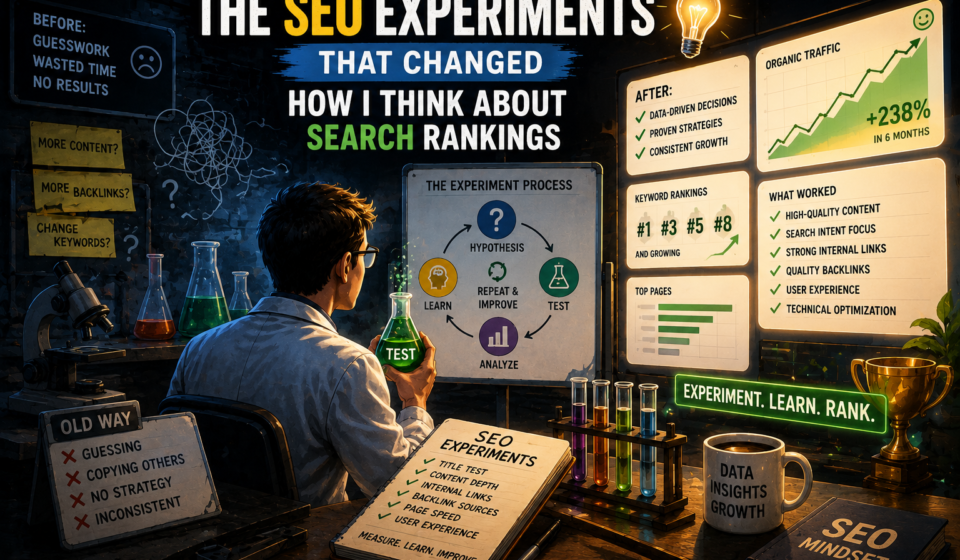
Publishing more does not always mean more traffic. Longer content is not automatically better. Exact keywords cannot replace search intent. Rankings can fluctuate, and old content can sometimes be more valuable than new content.
The biggest lesson is that experimentation is more useful than assumptions.
Every website is different, and what works today may need adjustment tomorrow. By testing ideas, measuring results, and focusing on users rather than shortcuts, website owners can develop SEO strategies based on evidence instead of speculation.
In the end, the best SEO experiment is often the one that makes the website genuinely better for the people who visit it.